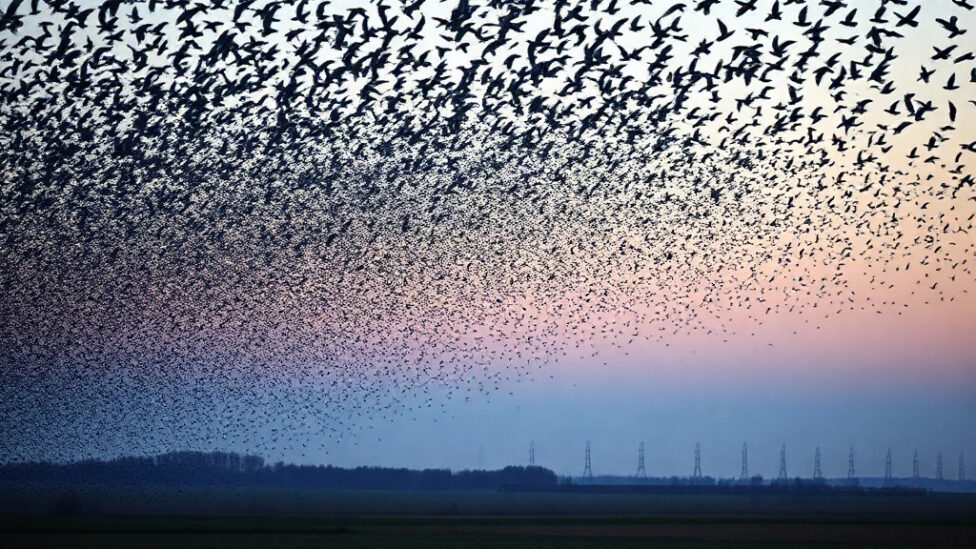
Starlings put on one of nature’s great shows at dusk. Thousands of birds twist and turn in tight, shifting flocks before they settle to roost, and scientists still do not agree on why they do it.
Researchers at the University of Gloucestershire are repeating a study from a decade ago, and they need help from the public to do it.
What the researchers want to know
The team is gathering records of where and when murmurations happen, how big each flock is and how long it lasts, and whether birds of prey are nearby. Professor Anne Goodenough, the lead researcher, said the team wants to see what has changed in the past decade, particularly because starlings are a declining species.
What the earlier study found
The original study, published in 2017, found an average of about 30,000 birds in a murmuration. Some of the largest flocks held more than 750,000 birds, and sightings came from 23 countries. It backed the idea that murmurations help protect the birds from predators such as peregrine falcons and sparrowhawks.
How to take part
You do not need any equipment. Report each murmuration you see during the autumn and winter, noting the place, the date and time, roughly how many birds there were, how long the display lasted and whether any birds of prey were around.
Records are submitted through the researchers’ online survey at https://forms.cloud.microsoft/pages/responsepage.aspx?id=U7fLnrmoG0-yBpcWknmKZ4bFgj0YojJHjif6N6q_BIpURDRCUlRLQjlXT0dJV1dUVDNaQ1RCVjI5TC4u&route=shorturl. Use this address to send your sightings, because the study depends on people reporting each one as they see it.
Prof Adam Hart, who co-wrote the original study, said almost anyone can contribute, and that simple observations from thousands of people can tell scientists more about this behaviour.