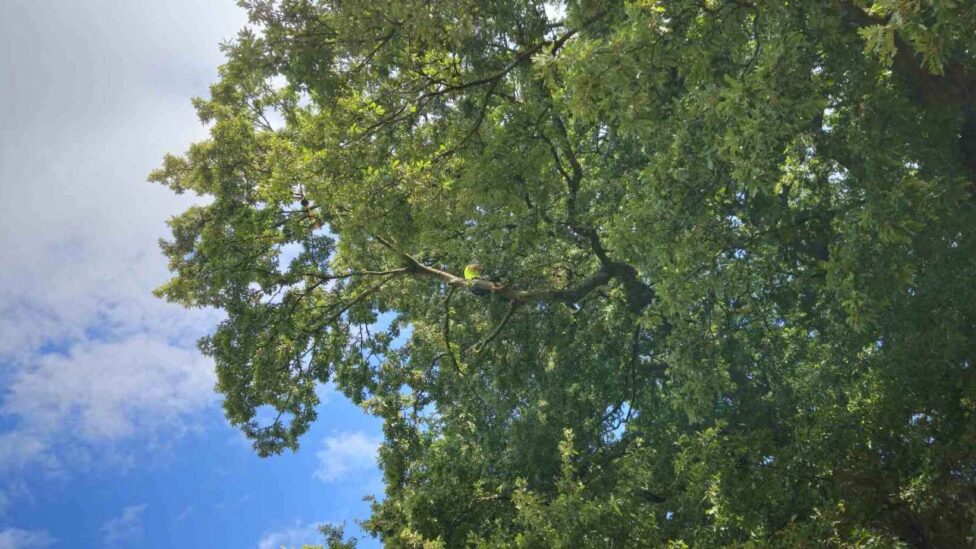
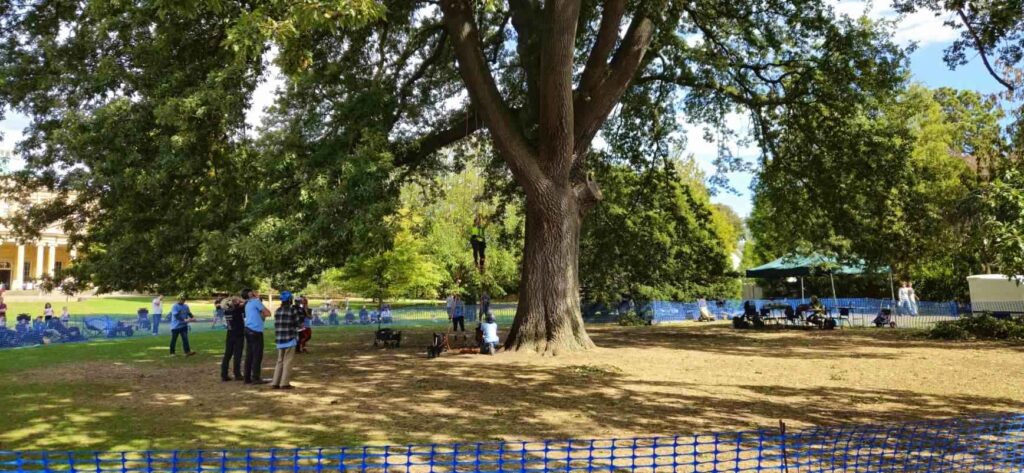
Cheltenham swapped its usual weekend crowds for a very different kind of spectator sport, as Pittville Park hosted the UK & Ireland Tree Climbing Competition (UKITCC) on Saturday 5 and Sunday 6 September. Around 50 of the country’s top arborists took to the park’s mature trees to compete for a place at the European Tree Climbing Championship, drawing curious crowds to one of Cheltenham’s best-loved green spaces.
Organised by the Arboricultural Association, the UKITCC is the longest-running and, by common consent within the industry, the pinnacle of tree climbing competitions in Britain. It began life in 1995 as the “UK/Ireland Skills Championship”, held at Lancaster University, and has grown into a fixture that tests professional tree surgeons on the skills they use every working day, just performed at speed and in front of an audience.
What competitive tree climbing actually involves
Far from a novelty event, the competition is designed to simulate real working conditions faced by professional arborists. Saturday’s preliminary rounds saw competitors tackle five separate disciplines:
- Ascent – testing how efficiently and safely a climber can use their ascent system to reach height and transition into a descent system.
- Throwline – a precision event in which climbers must accurately place a throwline through targets set 10 to 20 metres up in the tree, within a strict time limit.
- Aerial Rescue – simulating one of the most safety-critical scenarios an arborist can face, in which a competitor must climb to and safely lower an injured colleague.
- Work Climb – competitors move through the tree to five work stations, completing tasks such as using a handsaw or pole pruner, with points awarded for both speed and safe, controlled technique.
- Speed Climb – a straightforward race up a belayed line to 18 metres, rewarding raw climbing speed under safe conditions.
The leading men and women from those preliminary events progressed to Sunday’s Masters’ Challenge, the climax of the weekend, in which competitors are judged not just on speed but on their overall mastery of technique, equipment use and safe working practice in the tree.
The competition is run under International Society of Arboriculture (ISA) rules, with working practices reflecting current UK & Ireland technical guidance on tree climbing and aerial rescue – ensuring that what spectators see on the day mirrors genuinely safe industry practice, not just showmanship.
A stepping stone to the world stage
For competitors, Pittville Park was about far more than local bragging rights. Winners of the UKITCC go on to represent the UK and Ireland at the European Tree Climbing Championship and, ultimately, the International Tree Climbing Championship – a competition that draws climbers from across the globe.
The UK has produced some formidable talent on that international stage. Michael Curwen has held the men’s UK & Ireland title every year the competition has run since 2017, while Jo Hedger has won the women’s title an extraordinary 13 times, alongside six world championship titles of her own – including three in a row. Both went on to represent the UK & Ireland at last year’s International Tree Climbing Championship in Christchurch, New Zealand, with Hedger finishing an impressive second in the women’s division.
2026 marked a change of format for the competition, which for the first time was held independently of the Arboricultural Association’s annual conference, opening the door for it to move to new locations such as Pittville Park rather than being tied to a fixed conference venue.
Family fun alongside the main event
It wasn’t just professionals getting a workout among Pittville’s trees. Alongside the main competition, organisers ran a free kids’ tree climbing session in a nearby tree, giving children aged six and over the chance to have a go themselves under supervision – a popular addition that has proved a sell-out at previous UKITCC events elsewhere in the country.
Pittville Park, Cheltenham’s largest ornamental park and a Green Flag Award site, proved a fitting stage for the weekend. Laid out in 1825 and open to the public since the 1890s, the park is home to an extensive and historic collection of native and exotic trees, including some of the finest specimens in the country, making it a natural fit for a competition built entirely around skilful and safe work in the tree canopy.
For anyone who missed it, the Arboricultural Association is expected to publish full results and photographs from the weekend on its website in the coming days.